Experience unparalleled gaming performance with the lightning-fast speeds of fiber internet.
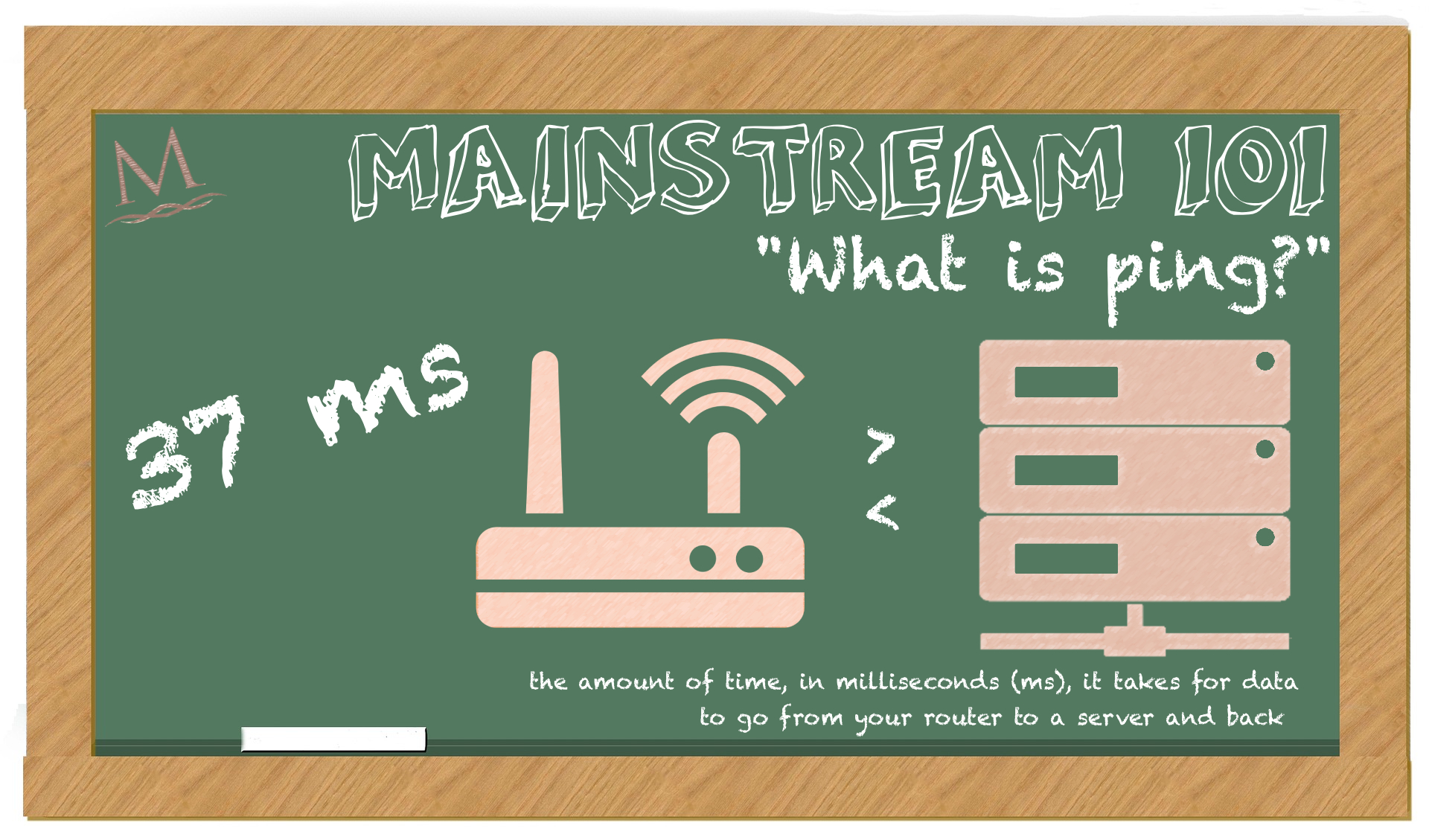
Get out your notebooks and #2 pencils, it's time for Mainstream 101! Today's lesson: what is ping?
If you've ever played many online games, especially competitive games like Call of Duty, League of Legends, Overwatch, Street Fighter 6 and many more, you may at some point have opened up the menu and seen an option to check your ping, which is usually represented by a number in milliseconds. For example, you may see your ping is 37 ms or 142 ms.
What does this number mean? And why does it matter to have a steady, consistent ping?
Ping = Distance + Speed
Simply put, ping is a speed measurement. It's how fast your inputs are registered, sent through your router to the game's server (or to the other player in the case of a peer-to-peer connected game), and then the output is returned back to you via that same pipeline. Unlike traditional internet speed measurements like megabits per second where you want a higher number, you actually want the opposite here. The lower this number is, the better. The average human reaction time is around 250 ms, so anything close to that number and you can really start to feel sluggishness, delay, and a lack of precision in input - what gamers call lag. Generally speaking, anything around 50 ms or less is considered very good for online play.
So, what gives you a good ping? There's a few factors, but the two biggest ones are:
1) Distance
How close you are to the game's servers in server-side games or to the other players in peer-to-peer games matters a great deal. It doesn't matter how awesome your speed is if the server you're attempting to connect to is halfway around the world - that's just a lot of distance to make up!
Obviously, there's not a ton of choice on your end in a peer-to-peer matchmaking game - the game's matchmaking will simply pair you up with someone it thinks you're of a similar skill level to and have a good connection with. In most of these types of games, you can choose to limit your possible options down to just players in your region, and that's usually a good call if you want optimal ping.
In server-side games such as MMOs like Final Fantasy 14 or World of Warcraft, or in MOBAs like League of Legends and DOTA 2, you're often given a choice of what server to play on. If given the choice, you should choose to connect to a server in your game that is as close as possible to your real-life location. Oftentimes, games will set you to a server by default, using your location to help it choose that default. But sometimes games can get this wrong or give you multiple options that are nearby, so it never hurts to check!
Obviously, this differs from game to game, but you'll often see the servers you should connect to listed as "US" or "NA (North America)" servers, and these should most of the time be the ones you pick. Luckily, here in the great state of Indiana, oftentimes game servers are placed in Chicago or other major Midwest cities due to its centrality to the entire rest of the country. That's less distance to travel, and that often leads to better ping for us Hoosiers!
2) Speed
This is where your internet service provider really makes a difference. As we mentioned earlier, ping is how fast information can travel up and down the pipeline from your input, to router, to server, and back. That's why both upload and download speed are so important. Any delay going up or down that pipeline can affect your overall ping, so it's vital to make sure you're getting both good upload and download speed.
Good news on that front! Mainstream Fiber offers fully symmetrical upload and download speed, so you should be able to send and receive as fast as possible without hitches coming up or down. And with our Work and Play 1 gig per second package, you can ensure you're getting the fastest possible speed in games where every second counts.
Frequently Asked Questions
Q: My ping often fluctuates - why is it not staying steady?
A: Some small amount of this fluctuation, often called a ping spike, is normal as your network deals with congestion, especially during hours of high amounts of traffic. But if you're seeing large swings between high and low ping, consider how you're connecting your gaming device to your router. If you're connecting via Wi-Fi, that technology's airborne nature can often introduce an amount of instability that leads to ping spikes. If you're serious about your online gaming, a wired connection via Ethernet is usually the superior choice!
Q: What can I do on my own if I'm experiencing high ping?
A: Aside from choosing the right server and getting a high, symmetrical speed, regularly performing a power cycle on your router can help clear your router's cache and clear up what is called "bufferbloat" - basically your router getting overwhelmed with too much information all at once. To perform a power cycle, simply unplug the router from power, wait 60 seconds, and then plug everything back in. It's like getting your router an extra life!